
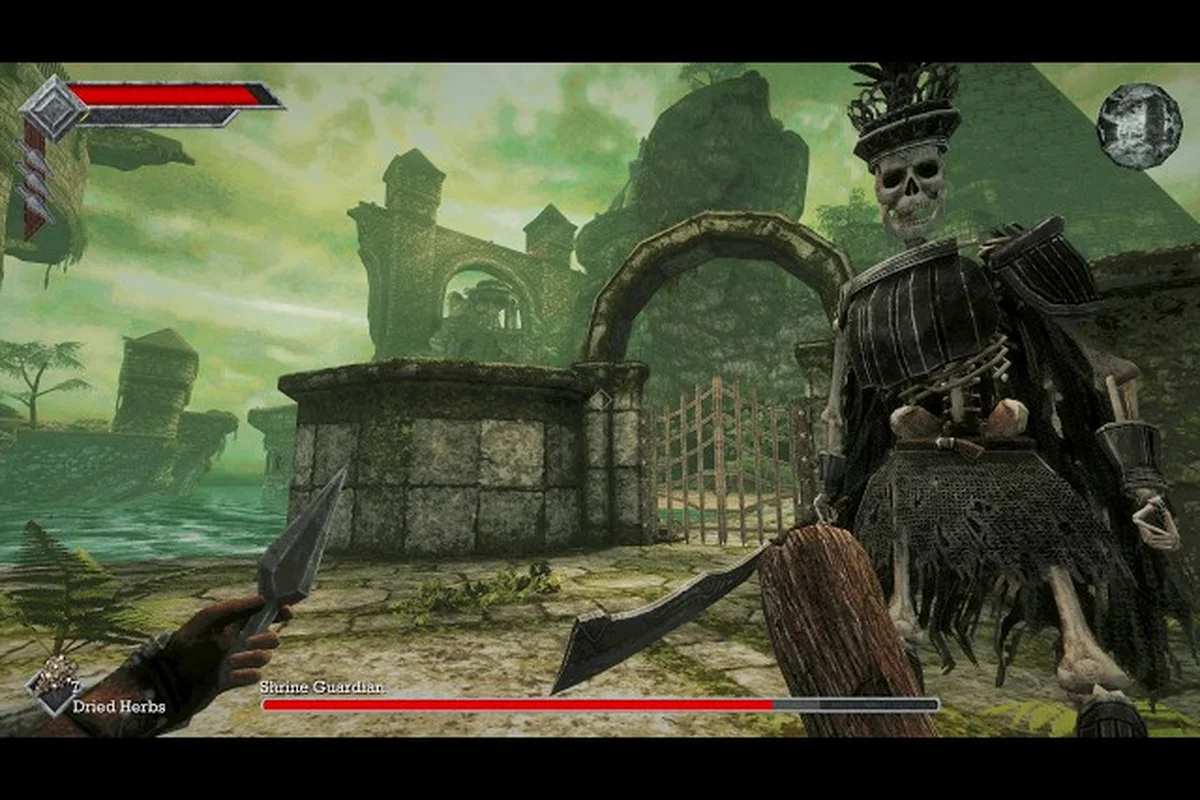
Queen’s Domain magic attacks matter because the developer’s “special / magic attacks” wording can be mistaken for a full spell system. The confirmed reality is narrower: weapon-specific melee specials, charge attacks, and secondary throwing options rather than a documented spell list.
What “Special and Magic Attacks” Actually Mean
The developer uses “special / magic attacks” in material describing Queen’s Domain combat, but that phrase does not establish a standalone spell system. The launch trailer shows stamina-based melee combat and throwing weapons, while the documented combat model confirms that every melee weapon has its own weapon-specific special attack. This distinction matters when evaluating queens domain magic attacks: the wording may describe what a special looks like in play without proving that players unlock spells from a separate menu.
The official Queen’s Domain news feed on Steam and the game’s public presentation support three confirmed attack families. Charge attacks add deliberate commitment to a melee action, melee weapons carry individualized specials, and secondary throwing weapons provide a ranged option. No separate spell list, spellbook, mana system, elemental spell school, or spell-casting stat was documented as of 2026-10-31.
| Confirmed attack option | What is documented | What remains unconfirmed |
|---|---|---|
| Charge attacks | Melee attacks can be charged | Exact windup, stamina cost, and damage |
| Weapon-specific special | Every melee weapon has its own special | Trigger method, cooldown, and scaling |
| “Special / magic attacks” | Phrase used in developer material | A separate spell list or spellcasting system |
| Secondary throws | More than 20 types exist | Exact names, damage, and unlock conditions |
| Melee attacks | More than 50 weapon types exist | A complete statistical ranking |
The most defensible interpretation is that magic attacks are the visual or functional expression of a weapon’s special, not necessarily spells purchased from a fantasy spell shop. A melee weapon can have a unique animation without being a casting implement, and a thrown object can have an unusual effect without establishing a new magic school. Since the game released on October 30, 2026, players should verify the current input prompts and descriptions in-game rather than relying on an assumed terminology system.
Confirmed facts versus common assumptions
This distinction keeps search answers accurate. Community discussions may group flashy weapon abilities under “magic,” but the only authoritative launch information establishes a weapon-specific special attack, not a catalog of independently unlockable spells. That also explains why official material has not supplied spell names, spell levels, or a school taxonomy.
| Search assumption | Evidence-based answer |
|---|---|
| Queen’s Domain has a conventional spell list | Not documented as of 2026-10-31 |
| Every melee weapon has a unique special | Confirmed by the developer |
| Charge attacks are the same as specials | No; both exist, but their exact relationship is not documented |
| Throwing weapons are spells | No; they are classified as secondary throwing weapons |
| Special attacks consume mana | Not documented; the confirmed resource is stamina |
| One weapon type is always objectively best | Not documented; compare handling, reach, and stamina use in game |
For broader weapon context, the Queen’s Domain weapons overview can help separate the large melee collection from secondary throws. Keep that distinction in mind: a large weapon count does not by itself prove that the game has dozens of spells, and a visually magical effect does not establish a separate casting system.
Weapon-Locked Specials Versus a Queen’s Domain Spell List
A weapon-locked special travels with the equipment that owns it. The game has more than 50 findable melee weapons, and every one is documented as possessing a distinct special attack. That structure suggests experimentation with equipment behavior, while the absence of a published spell catalog leaves open questions about whether specials can be altered, leveled separately, or equipped as a separate ability.
The crucial verification question is not “Where is the spell menu?” but “How does this equipped weapon behave?” The answer may appear through the weapon’s own description, an attack prompt, a move list, or visual evidence when the input is used. None of those interface locations was documented in the launch materials, so screenshots and firsthand testing are more reliable than assuming a conventional fantasy interface.
How to classify an ability you encounter
Use the following four-question test before treating an effect as a spell. This avoids inventing terminology while producing a consistent personal inventory of available moves. Apply it to observed behavior, not visual effects alone: for example, a charged melee animation that consumes stamina may be a charge variant, while a secondary thrown object such as a throwing dagger can be classified as a throwing attack even if it resembles a spell. Record the weapon dependency, activation method, stamina cost, and whether the effect appears in a separate ability menu; if any point remains undocumented, label it unconfirmed rather than extrapolating a hidden magic system.
-
Does it appear only while that weapon is equipped? If yes, classify it as a weapon-specific special unless the game explicitly labels it otherwise.
-
Does it require a separate spell entry or selection screen? If yes, it may function as a standalone ability, but verify the in-game label because the official wording remains broad.
-
Does it draw from a resource besides stamina? No additional magic or mana resource was documented as of 2026-10-31, so treat this as unconfirmed until observed directly.
-
Can it be equipped independently of its weapon? If not, it is functionally tied to the weapon even if its animation resembles magic.
| Classification test | Likely category | Reason |
|---|---|---|
| Bound to one equipped melee weapon | Weapon special | Matches the confirmed system |
| Available through a separate ability menu | Potential standalone spell | Requires in-game evidence |
| Uses stamina rather than another resource | Combat action | Fits the documented combat model |
| Performed with a secondary thrown object | Throwing attack | Officially described as a secondary weapon |
| Triggered only during a charged melee | Charge variant | Distinct from the weapon’s named special |
This classification also helps when comparing builds. A special that is convenient with one weapon may be less useful with another because movement, reach, and attack rhythm change. The Queen’s Domain combat guide is useful for checking how charge attacks and stamina pressure fit into a broader encounter plan, but it should not be treated as evidence of a hidden spell system.
What weapon ownership means for build variety
Weapon-specific specials encourage switching rather than stacking every flashy move into one loadout. However, the game does not document whether multiple melee weapons can be carried, whether specials can be assigned to shortcuts, or whether weapon evolution changes their behavior. The official patch record confirms that weapons can evolve because version 1.01.01 addressed a freeze during that process, yet it does not state what evolution changes.
This creates a practical progression loop: treat each melee weapon as a distinct combat kit rather than stacking several specials that share the same stamina, reach, and recovery constraints. A throwing dagger may offer better spacing and faster repositioning than a heavier melee weapon, but only testing can confirm whether that advantage survives the special’s attack commitment. Because weapon ownership changes what can be equipped, the useful comparison is between practical battlefield roles—close-range pressure, ranged harassment, and safe disengagement—rather than an invented “magic weapon” tier. This matters especially for Queens Domain throwing weapons and secondary weapons, where reach and animation duration may determine whether a special is usable during pressure rather than merely impressive in an empty room.
-
Obtain a melee weapon and learn its normal attack rhythm.
-
Trigger its special in a safe area to observe the animation and resource use.
-
Compare how the special fits the weapon’s reach and movement.
-
Record whether repeated use drains stamina differently from ordinary attacks.
-
Test the weapon again after upgrading or evolving it, if applicable.
This is more useful than assigning an invented tier to “magic weapons.” No elemental damage chart, spell cooldown table, or magic scaling stat was published as of 2026-10-31. Any comparison of special effects should therefore be framed around observable combat value: stamina efficiency, attack commitment, range, and recovery space.
Queen’s Domain Throwing Weapons as the Ranged Option
Queen’s Domain throwing weapons are the documented ranged counterpart to melee combat. The developer states that more than 20 types of secondary throwing weapons exist, so they form a meaningful part of the arsenal rather than a single decorative item. They should not be confused with magic spells, and the term “queens domain secondary weapons” is the clearest official category to use when recording them.
A likely reason to switch to a throw is separation. It can create space from a dangerous creature, interrupt an approach, or provide an alternative when the currently equipped melee weapon’s normal rhythm does not suit the encounter. The exact throw speed, arc, damage, and ammunition behavior are not documented as of 2026-10-31. Player experience is therefore valuable for establishing practical details, but it should not be converted into universal numeric claims.
| Ranged need | Throw decision | Limitation to verify |
|---|---|---|
| Create distance | Equip a secondary throw and attack while retreating | Movement speed while aiming or throwing |
| Interrupt an enemy | Try a throw before committing to melee | Whether the target can be staggered |
| Preserve melee stamina | Replace one close-range action with a throw | Throw stamina cost |
| Fill an awkward angle | Test a throw against distant or moving enemies | Tracking accuracy |
| Finish a weakened enemy | Compare throw damage with the equipped weapon | Damage scaling and durability |
Searches for queens domain throwing daggers naturally raise the question of whether daggers form a separate category. The launch information does not publish the names or classes of the 20-plus secondary weapons, so it cannot confirm dagger count, rarity, or specialization. Verify dagger properties in the inventory and training area rather than assuming that a dagger has faster speed or lower stamina use than every other throwable.
Budgeting throws alongside stamina-based melee
The confirmed combat resource is stamina, and charge attacks, melee combos, and special attacks all need to be considered when judging any ranged option. Exact stamina values and regeneration timing are not documented, so build decisions should use relative observations: one throw, several basic swings, or a charged attack before the meter becomes unavailable.
A practical test session can separate the main variables by isolating each Queens Domain action and watching the stamina meter rather than judging the whole weapon at once. For example, test a throwing dagger after allowing the meter to refill, then repeat immediately after a melee combo or charged attack; if the throw consumes noticeably less stamina than the combo, it may preserve mobility for evasive movement and rapid secondary attacks. This comparison helps distinguish a genuinely cheap Queens Domain magic attack from one that only feels efficient because the preceding action was interrupted or the weapon’s special had not yet been triggered.
-
Stand in a clear area and note how long the stamina bar takes to recover.
-
Perform one standard melee sequence and record the apparent cost.
-
Repeat with a charged melee attack and note the additional commitment.
-
Trigger the equipped weapon’s special and compare the resulting stamina state.
-
Throw a secondary weapon, then repeat with a different throw if available.
-
Check whether the throw changes the meter at all and whether it can be used while moving.
Because the game launched only days before this guide’s verification date, patch changes may also affect Queens Domain magic attacks, including throwing-dagger stamina costs, stamina regeneration timing, and the balance between melee combos and secondary attacks. Treat current results as provisional rather than permanent rules: after an update, repeat the same controlled sequence—standard melee sequence, charged melee attack, weapon special, then a throw—and compare both the meter’s remaining amount and the recovery delay. This makes it possible to separate a genuine balance adjustment from normal variation caused by animation timing or unavailable stamina.
The weapon upgrade and evolution guide adds another useful variable: a throwable may change after an upgrade, while the official patch note only confirms that evolution exists. Compare the same secondary weapon before and after modification when possible, and record whether the visual effect, range, or resource behavior appears to differ.
Choosing the right weapon type for an encounter
There is no documented numerical answer to the Queens Domain best weapon type question. The responsible comparison depends on the encounter and the player’s ability to read stamina pressure. Rather than treating melee, throwing daggers, charge attacks, or an unfamiliar weapon special as a fixed upgrade, test the option that fits the current enemy spacing and threat pattern, then use the encounter conditions in the table below to narrow the choice.
| Encounter condition | Better fit to test | Why |
|---|---|---|
| Narrow space with several close enemies | Melee weapon | Avoids relying on a throw that may miss |
| Open area with a threatening approach | Secondary throwing weapon | Offers a way to create space |
| Heavy enemy with slow visible movement | Charge attack | Rewards deliberate timing |
| Unfamiliar enemy behavior | Basic melee attack | Easier to compare without special variables |
| Weapon with an unfamiliar special | Training first | Prevents animation surprises in a real fight |
This framework does not claim a parry, blocking, or perfect-dodge system. Those mechanics are not documented by the developer as of 2026-10-31, and media previews that mention parrying should not be used as proof of its presence or timing.
Melee Combat Fundamentals That Still Apply
Queen’s Domain melee combat centers on stamina, charged attacks, and each weapon’s individual special. Because more than 50 melee weapon types exist, the key combat skill is not memorizing one globally best build; it is learning how reach, recovery, and special commitment change the stamina budget.
Start with short, controlled exchanges rather than trying to spend the entire meter in one sequence. The official wording confirms a classic stamina model, but it does not publish regeneration speed or the stamina cost of any move. Observe the meter before and after each action, because animation length alone does not reveal the underlying budget. A visually short special may still require more recovery than a longer normal swing.
| Combat decision | Practical question | Evidence to record |
|---|---|---|
| Normal swing or charge? | Is there enough room to recover? | Stamina left after the action |
| Melee or secondary throw? | Can distance solve the threat? | Enemy reaction and throw usefulness |
| Equip a new weapon or learn the current one? | Is its special worth the adjustment? | Success during the first few encounters |
| Continue the combo or disengage? | Is another attack responsible? | Meter and nearby enemy position |
| Test on a standard enemy or a boss? | Has the normal behavior been learned? | Consistency of results |
Stamina as a decision budget is more reliable than a fixed combo recommendation because weapon animation, enemy behavior, and player spacing all affect what happens next. You can expand the Queen’s Domain life-points and combat overview to cover survival priorities, but avoid turning undocumented dodge timing or poise into fixed rules.
Build a repeatable special-attack test
A controlled test produces more reliable information than winning one difficult encounter. Find a noncritical area with a standard enemy, equip the weapon you want to evaluate, and use the same opening situation for every attempt. For example, test Queens Domain magic attacks with one throwing-dagger setup and one secondary-weapon setup against the same target, keeping the opening distance and stamina unchanged. This isolates whether the move’s damage, reach, or stamina cost comes from the weapon choice rather than the enemy or encounter difficulty, making comparisons between throwing weapons and secondary weapons easier to interpret.
-
Start with full stamina and the same distance from the target.
-
Perform one ordinary attack to observe the baseline rhythm.
-
Trigger the special after the same opening action.
-
Record whether it advances, retreats, stays in place, or targets differently.
-
Note the meter state immediately after recovery begins.
-
Repeat until you can identify the move without relying on its animation alone.
-
Compare results with a secondary weapon equipped, since some moves may draw from the same resource pool.
This test does not reveal hidden damage multipliers unless the game displays them. It does reveal practical differences that affect survival: whether the special creates useful distance, whether it can be canceled, and how much stamina remains for a follow-up. Those observations are more actionable than unsupported percentages.
Match commitment to enemy pressure
Charge attacks are appropriate when an enemy’s movement leaves a predictable opening and the arena gives you room to finish the motion. Special attacks deserve similar discipline. Use them when the surrounding space supports the animation, not merely because the meter happens to be full.
Against multiple close enemies, a long committed animation may be harder to use safely than a shorter basic attack. In an open area, a special that changes position could be useful even if it does not end the encounter. For throwable options, test them both as an opener and as a response to an enemy moving through a predictable angle. The result may depend on the target, so record patterns rather than assuming every creature behaves the same way.
| Situation | Combat priority | Special or throw role |
|---|---|---|
| Enemy closes rapidly | Maintain space | Use a throw only if it helps create separation |
| Enemy pauses before striking | Commit to a charge | Avoid stacking another long animation afterward |
| Several enemies surround you | Keep actions simple | Save the special for a clear opening |
| Weapon special improves positioning | Learn its timing | Treat movement value as a separate benefit |
| Stamina reaches a low point | Stabilize | Do not infer unseen regeneration rules |
A successful queens domain combat tips routine is therefore adaptive: observe, commit, check the meter, and leave enough room to respond. That method remains valid even when patch updates alter exact numbers, because it focuses on relationships rather than fabricated values.
Testing a Weapon’s Special in Queen’s Domain
The most reliable way to document Queen’s Domain magic attacks is to inspect the equipped weapon, trigger it, and record observable behavior. The official launch information does not provide a complete guide to the interface, special prompts, or exact upgrade effects, making an in-game verification checklist essential.
Start by checking every available melee weapon in your collection and noticing whether its description identifies a special. If the game presents a separate special or ability menu, record that separately rather than assuming it contains spells. Compare the wording on the menu with the broader “special / magic attacks” phrase used in promotional material.
Checking a Weapon Special's Behaviour
Use a quiet location for the first attempt and note each result before moving on, especially when testing Queens Domain magic attacks alongside a melee weapon or secondary throwing weapon. Record the exact prompt, timing, range, and stamina consumption so the magic animation is not mistaken for a separate system later; for example, note whether the attack begins only after the weapon’s special input or whether it consumes stamina independently. This controlled setup makes later comparisons with normal and charge attacks more reliable.
- Identify the equipped melee weapon.
- Read its in-game description and note any named special.
- Find the input or prompt that activates the special.
- Trigger it once with full stamina.
- Record movement, range, animation length, and apparent stamina effect.
- Compare it with a normal attack and a charge attack.
- Equip a secondary throwing weapon and compare its resource use.
- Repeat after any upgrade or evolution.
- Save the observation in a dated note.
The dated note is important because version 1.01.01 already fixed several technical issues, including a freeze during weapon evolution. It is sensible to note the version used for each test, although the developer has not published a promise that future updates will change any particular special.
Record what the game does not explain
Some questions cannot be answered from the menu alone. Damage numbers may be absent, enemy defense may not be disclosed, and no official elemental chart has been published. In those cases, compare relative outcomes under controlled conditions rather than inventing formulas.
| Observation | Safe conclusion | Unsupported conclusion |
|---|---|---|
| Special animation is longer | It creates greater commitment | It deals a specific percentage more damage |
| Meter drops after use | It consumes part of the stamina budget | It has an exact stamina cost |
| Throw connects from farther away | It offers useful range | It has a fixed maximum distance |
| Weapon changes after evolution | The upgrade affected that weapon | Every evolved weapon gains stronger stats |
| Enemy reacts differently | The move affected that target | The special has a guaranteed stun |
Community reports can fill in practical experience, but they should remain labeled as player observations. The official Queen’s Domain Steam community page exposes achievement information, while the game’s official launch trailer on YouTube visually confirms throwing tools and stamina-driven melee. Neither source publishes a complete spell list, so neither can close the missing-data gap.
Make a personal special inventory
A simple inventory prevents repeated testing and makes comparisons clearer. Create one row per melee weapon and one row per secondary throw, including Queens Domain throwing daggers and other throwing weapons, while leaving unknown fields blank rather than guessing. Record the weapon’s exact in-game label, named special, activation prompt, stamina effect, range or movement requirement, and upgrade note; this separates verified mechanics from observations and lets you compare repeated tests against the same melee or secondary-weapon behavior.
| Weapon | Named special | Activation prompt | Stamina effect | Range or movement | Upgrade note |
|---|---|---|---|---|---|
| Record in game | Record exact label | Record only if shown | Relative observation | Relative observation | Record after change |
| Record in game | No published label yet | Verify in game | Relative observation | Relative observation | Use a dated note |
This method is especially useful for deciding which weapon deserves more testing. A special that looks impressive but leaves little stamina for recovery may be less dependable than a straightforward attack, while a throw that repeatedly creates space can be more valuable than a visually flashy ability. The evidence-based conclusion can change as the player learns the roster and patches land.
Frequently Asked Questions
Does Queen’s Domain have a full spell list?
No full spell list was documented as of 2026-10-31. The developer confirms weapon-specific special attacks and uses the phrase “special / magic attacks,” but that wording does not establish independently unlockable spells, spell levels, a mana system, or named schools. Verify the equipped weapon’s description and any separate ability menu in-game before classifying an effect as a spell.
Are Queen’s Domain throwing weapons spells?
No. The developer describes more than 20 types of secondary throwing weapons, placing them alongside melee equipment as a ranged option. Their effects may look unusual, but official material does not classify them as magic spells. Exact names, damage values, durability rules, and throw speed are not documented as of 2026-10-31.
What is the best weapon type in Queen’s Domain?
There is no verified universal winner because damage, reach, stamina cost, and enemy matchups are not published in a complete comparison table. The best practical choice depends on the encounter, available space, and how efficiently the weapon uses stamina. Test normal attacks, the special, charge attacks, and secondary throws under similar conditions before deciding.
How do you test a weapon’s special attack safely?
Equip the weapon in a low-risk area, check its description, and trigger the special with full stamina. Compare its movement, recovery, and remaining meter with a normal attack and a charge attack. Repeat after upgrades or evolution because weapon behavior may change, and keep a dated note so observations can be reassessed after patches.
Can Queen’s Domain melee combat be mastered without magic spells?
Yes. The confirmed combat model includes more than 50 melee weapon types, stamina-based attacks, charge attacks, and a weapon-specific special for every melee weapon. A practical mastery loop is to learn each weapon’s normal rhythm, measure the apparent stamina cost of its special, and decide whether it offers enough range or movement value to justify that commitment.