
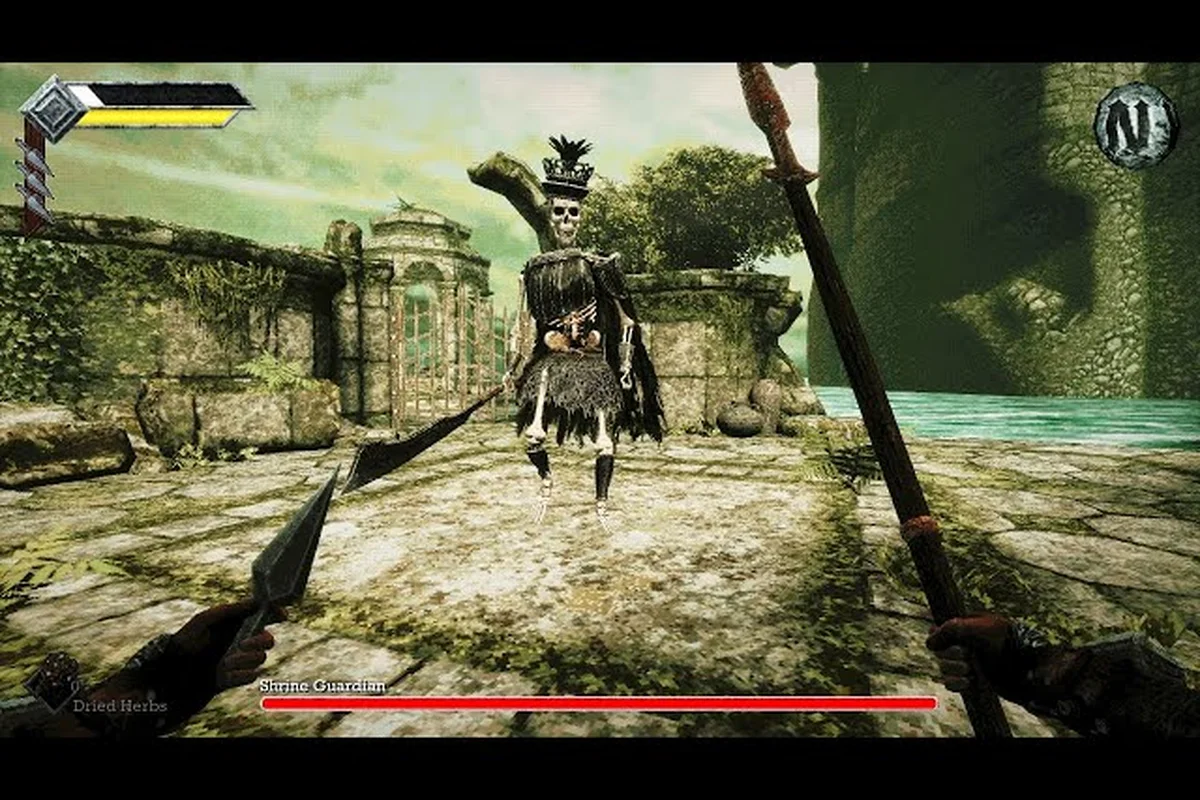
Queen's Domain collectible locations cannot be copied from a published checklist, because the developer has released no item map, coordinates, or guaranteed count. The useful approach is to treat the island as a field-research problem: observe, record, and verify every find in your own run.
Queen's Domain Collectible Locations: What Has Been Published
Queen's Domain collectible locations require careful field research because the developer has not published a complete checklist. The available official information describes one interconnected island, the Isle of Neasied, and a separate named hazard called the Pit of Despair. It does not identify individual collectibles, their exact coordinates, a world map, or a guaranteed count of secrets.
This distinction matters for players searching the Queens Domain island. A collectible can exist in the game without having an official name or documented marker, while an achievement title may describe a milestone rather than a physical item. The official Steam news feed for Queen's Domain confirms several technical fixes and the existence of water return pits, but it does not supply a treasure map.
The following table separates what players can verify from what remains unknown as of 2026-10-31. Its distinctions follow the official record for the Isle of Neasied, the Pit of Despair, and the water return pits: an identifiable place is not proof of a collectible, while an achievement title is not necessarily a map marker. That distinction matters because it prevents an invented “treasure map” from being mistaken for documented Queen’s Domain collectible locations.
| Question | Verified information | What remains undocumented |
|---|---|---|
| Where does exploration begin? | The player arrives on the shore of the Isle of Neasied | Exact starting coordinates |
| How many land areas exist? | One interconnected island | A region list or boundary map |
| Are there named locations? | Isle of Neasied and Pit of Despair | Other official location names |
| Is there a published collectible list? | No | Item names, totals, rewards, and coordinates |
| Is there an official world map? | No published map was available at launch | Full layout and scale measurements |
| Can players return after falling into water? | Water return pits send them back | Their complete locations and activation rules |
That evidence limits any definitive list of Queen's Domain collectible locations. A responsible guide should instead teach a repeatable field-research process: explore the Isle of Neasied and the Pit of Despair systematically, record whether each unusual object produces a distinct pickup effect, and separate confirmed discoveries from scenery that merely resembles a collectible. Because the game has no published collectible total, exact coordinates, item names, or world map, a documented screenshot with its surrounding landmark provides more reliable evidence than assigning an invented label. This approach also prevents the Pit of Despair or a water return pit from being misidentified as a collectible location merely because it is a prominent feature of Queen's Domain.
Distinguishing Finds from Confirmed Rewards
Before cataloging a suspicious object, separate it into one of three categories: an obvious pickup, an interactive environmental clue, or a milestone associated with an achievement. The first category belongs in an item log. The second needs a screenshot and location note, because it may only have environmental significance. The third should be logged as a completion event rather than assumed to represent a collectible.
53 Steam achievements exist, but only ten public display names have been published. Those names include Unsealed Tomb, Halls of Hatred, Sacred Groves, Deep Mire, and Sin Keeper. They reveal useful vocabulary for recording progress, although an achievement title does not prove that its destination is a distinct map region or a physical collectible.
The Queen's Domain Steam Community page currently exposes those achievement names while withholding every unlock condition. Treat the titles as milestone labels. Do not turn them into a region list, because doing so would manufacture a structure the developer never provided.
A Safe Logging Standard
A reliable personal log should contain five fields for every notable discovery: date, general area, approach direction, visible interaction, and status. For example: “West shoreline, facing inland, elevated stone platform, blue-lit object, collected.” Avoid directional claims unless they remain recognizable after returning.
Use Confirmed pickup, Unverified interactable, and Achievement milestone as separate status labels. This small distinction preserves accuracy, especially when the same object later proves to be scenery, a shortcut control, or a quest-related device whose exact function is not documented.
Is Queen's Domain Open World?
Is Queen's Domain open world? The most defensible answer is that it uses an interconnected, open-style island structure, although the developer has not formally labeled the game “open world.” Official materials describe one connected island full of secrets and shortcuts, with flight as the central way to cross gaps and cliffs acting as major barriers.
That definition matters because “open world” can mean several different things. A game may offer continuous terrain without using it, or it may use a hub and seamless areas rather than a rigid level list. Queen's Domain is clearly built around connected exploration, but the exact freedom of movement, region count, and progression boundaries are not documented as of 2026-10-31.
| Structure model | Evidence for Queen's Domain | Limitation |
|---|---|---|
| Linear rooms and corridors | Early areas may funnel players through obstacles | No room list or chapter structure is published |
| Hub-based zones | Several destinations appear reachable from shared terrain | No formal hub or region names are documented |
| Seamless interconnected island | Officially described as one island with secrets and shortcuts | Exact layout and traversal time are unknown |
| Fully open sandbox | The island supports exploration and flight | Freeform goals, builders, and open-world labels are not documented |
The practical answer is therefore “open-style, with progression gates.” You can redirect your route, return to earlier spaces, and search alternative ledges, but cliffs can prevent immediate access. This is closer to layered exploration than a flat landscape where every destination is visible from the start.
Navigation That Respects the Island Design
The Legendary Holy Sword Endu provides flight between platforms, while sword upgrades extend its range. When searching for Queen's Domain collectible locations, treat flight not only as transportation but also as a visual scanning method. From a safe landing point, fly to the next reachable platform and look back toward the area you crossed.
Water return pits reduce the cost of exploration mistakes. Version 1.01.01 corrected missing return pits around Neasied, according to the official news feed, so a fall that previously interrupted a search should now return you to land more reliably. Still, save before difficult aerial routes because fall handling is not the same as a full checkpoint system.
The broader Queen's Domain map overview can help with general orientation, but it cannot replace an item coordinate list because no such official list has been published. Use the island's landmarks, rather than fictional region names, as your stable reference points.
The Boundary Between Open Exploration and Gating
Open-style navigation does not mean every collectible is available on arrival. A visible platform may require a longer Endu flight, an upgraded sword, or a route discovered from the opposite side. Before marking an object unreachable, check the surrounding cliffs from multiple elevations and inspect whether a natural bridge or concealed shortcut continues beyond the immediate platform.
At the same time, do not build an elaborate gate-theory chart from assumptions. The game has no published region list or chapter structure, and no exact condition for every collectible is documented. A note such as “visible from lower route; access blocked by cliff; possible flight route from upper ledge” captures what you know without pretending the solution is confirmed.
How Big the Isle of Neasied Is
How big is the Queen's Domain map? There is no official measurement in square kilometers, screen count, or traversal time. The developer describes one interconnected island and markets the overall game as an experience of at least 40 hours, with more than 100 enemies, mini bosses, and bosses combined. Those figures communicate substantial scope, but they do not establish the island's exact dimensions.
For practical navigation, measure the Queen's Domain island by connectivity, elevation changes, and revisit distance rather than a nonexistent map scale. The official world description emphasizes secrets, shortcuts, gaps, cliffs, and flight. Those features can make a compact-looking journey feel extensive because reaching the same landmark may require circling a ravine, descending a cliff, or returning through a water pit.
| Scale clue | Confirmed detail | Why it matters for a collectible search |
|---|---|---|
| Overall playtime estimate | At least 40 hours | The island is part of a substantial exploration experience |
| Enemy density | More than 100 enemies, mini bosses, and bosses combined | Collectibles may require combat and route planning |
| World form | One interconnected island | Revisits are central to exploration |
| Movement | Flight across gaps with the Legendary Holy Sword Endu | Height can reveal separated platforms |
| Main barrier | Cliffs | Some routes may remain inaccessible without upgrades |
| Return system | Water return pits | Some failed jumps lead back into the exploration loop |
For collectible hunting, the scale of the Isle of Neasied matters less than the number of route changes required to sweep it. The documented 40-hour minimum and 100+ enemies, mini bosses, and bosses indicate a substantial quest chain, while the interconnected island, cliffs, gaps, flight with the Legendary Holy Sword Endu, and water return pits explain why nearby landmarks may require lengthy detours. Thus, the defensible answer is substantial and interconnected, not a specific acreage figure: no official square-kilometer, screen-count, or traversal-time measurement establishes the map’s physical area, and the world’s vertical layers make a flat acreage estimate misleading.
Building a Useful Personal Scale Model
Create three navigation tiers when you begin exploring the Isle of Neasied. The first is local, covering a single cliff cluster or shoreline. The second is landmark-based, linking a shoreline to a major silhouette, structure, or unusual formation. The third is return-oriented, recording whether a shortcut exists between two landmark clusters.
This method makes logs comparable without inventing region names. A local entry can say “western cliff shelf, descending toward the shoreline,” while a landmark entry can say “large elevated silhouette, visible from the beach.” Both are reproducible without depending on compass headings that may differ in practice.
For aerial scouting, record three fixed attributes: the target's height relative to the current platform, the approximate direction of the gap, and whether another landing point exists beyond it. These notes help you reconstruct the route later, especially when the Holy Sword Endu reaches a different distance after upgrading.
What the Playtime Estimate Does Not Prove
The 40-hour figure covers the whole experience, not only the island. It also does not prove that every route, hidden object, or optional encounter is required for completion. Treat it as evidence of overall scale, not as an estimate of how long a collectible hunt will take.
Combined enemy counts above 100 do not establish how many defeats are needed for a specific milestone, because the achievement’s unlock conditions remain unpublished. This uncertainty makes any mandatory-collectible checklist unreliable: a total of 100+ enemies could include optional encounters, repeated encounters, or enemies encountered during the island’s main route. Until official requirements clarify the threshold, treat enemy totals as scope indicators rather than completion requirements.
For the broader question of game length and pacing, the Queen's Domain difficulty and duration overview provides useful context without pretending that the 40-hour estimate is an exact completion time. The figure describes the scale of the full Queen's Domain island experience, whereas a collectible-focused route may be shorter if it avoids optional encounters, repeated enemy encounters, hidden objects, and lore locations. It therefore works better as a planning benchmark than as a guaranteed timer for finding every collectible.
Queens Domain Lore Locations and Evidence Gaps
Queens Domain lore locations are easier to discuss in terms of evidence than as a fixed list. The player's stated purpose is to find a missing father while uncovering the island's dark heart and the stir of a sleeping Queen. That premise supplies story direction, but it does not provide coordinates for lore objects, named shrines, or labeled landmarks.
The confirmed geographic vocabulary is small: Isle of Neasied and Pit of Despair. The latter is a named hazard associated with a documented soft-lock issue, not an official collectible category. No other locations, NPCs, chapters, or lore-site lists were published as of 2026-10-31.
| Evidence type | Examples | Safe conclusion |
|---|---|---|
| Official place name | Isle of Neasied | The main exploration setting |
| Official hazard name | Pit of Despair | A dangerous named destination |
| Public achievement label | Unsealed Tomb | A milestone label, not confirmed geography |
| Public achievement label | Deep Mire | A milestone label, not confirmed geography |
| Environmental observation | Strange object, inscription, or structure | A candidate lore location to document |
| Community report | Player-described landmark or interpretation | Useful clue, but verify in game |
This distinction keeps a personal atlas from turning achievement titles into fictional regions. Unsealed Tomb may sound like a location, but its condition is not documented, and it may be tied to an action rather than a place you can mark on a map.
Building a Lore-Location Dossier
For each lore candidate, record five observable details: material, shape, sound, environmental context, and interaction outcome. If an object produces a visible response, include the exact response rather than interpreting its narrative meaning. This preserves evidence before it becomes lore speculation.
For example, an entry might read: “Carved slab beside a lower cliff, rectangular, emits a brief light when approached, no item window observed.” Another might say: “Isolated structure beyond the shoreline, no interaction registered from two approaches, exact meaning unknown.” Both entries are useful because they distinguish an interactable clue from scenery.
Use the in-game bestiary only for named creatures and recorded entries. The bestiary can be scrolled with a controller, but it is not documented as a map database. Four creature names are officially established: Mimic, Star Lizard, ojum lizard, and eye plants. Do not invent lore names for anonymous enemies or structures.
What Player Reports Can Add
Community reports can help prioritize a return visit, especially when several players notice an unusual object or route. Phrase those reports as observations rather than facts. “Player reports suggest a ledge near the coast contains an interactable” is appropriate; “the message is on page three of the ending” is not unless the player documented the sequence in a verifiable way.
No confirmed subreddit exists, and the developer’s official Discord is available, but neither replaces in-game verification of Queen’s Domain collectible locations. Use discussions to compare landmark descriptions—such as the coastal ledge or an island route—then cross-check the object’s appearance, surrounding landmarks, and required interaction against your own run before recording it. Label an unverified report as provisional rather than adding it to a definitive personal collection, since lore clues, bestiary entries, and achievements may point to the same landmark without confirming the collectible itself.
The Queen's Domain beginner guide can support a broader exploration setup, but its bestiary entries, achievements, and lore clues should remain separate evidence types rather than being merged into an invented codex. A bestiary entry may identify a creature encountered near a coastal ledge, while an achievement may only confirm that the player visited the wider island route; neither necessarily proves that a hidden collectible was obtained. For example, if the guide mentions a lore marker on Queen's Domain’s island, record that marker as a lead, then verify the object’s appearance and required interaction in your own run before counting it toward the personal collectible list.
Logging Collectibles Without a Tracker
Logging Queen's Domain collectible locations is currently the most reliable way to build a personal checklist because no official tracker, published world map, or complete collectible index is available. A simple spreadsheet can track an item, a probable category, a general area, an image, and its verification status. The goal is to create evidence you can understand after navigating away from the find.
Start with a row for every confirmed pickup. Then add separate rows for ambiguous interactables and achievement milestones. Keep Pickup ID as a stable number, even if you later change the displayed description, because it prevents duplicate entries after revisiting a location.
| Log field | Example entry | Reason it matters |
|---|---|---|
| Entry ID | ISL-014 | Provides a stable reference |
| Display name | Blue-lit object | Describes what you saw |
| Category | Unverified interactable | Avoids treating every glow as a pickup |
| General area | Coastal cliff shelf | Survives imperfect map labels |
| Approach | From inland landing | Reconstructs the route |
| Evidence image | Timestamped screenshot | Confirms visual state |
| Status | Verified in game | Shows whether the note is confirmed |
| Access note | Endu flight from upper ledge | Records how to return |
Screenshots should include surrounding terrain whenever possible, because a tight image of a glowing object may become difficult to identify after navigating away from the Queen’s Domain island. For example, pair the blue-lit object on a coastal cliff shelf with the cliff edge, nearby tree, waterline, or ruined architectural fragment in the frame; those fixed landmarks make the location easier to match than the collectible’s glow alone. Add a timestamp or route note when practical, since a screenshot may show the object but not how you reached it.
A Repeatable Survey Pass
Divide the island into search units rather than trying to cover everything in one continuous run. Start at an accessible shoreline, move to the nearest stable landmark, scan for separated platforms, and return along the same route. Repeat the circuit in the opposite direction so that back-facing surfaces and lower ledges receive equal attention.
At every potential find, test the interaction once, wait briefly for any menu or pickup response, and move away before judging the result. Some menus can be dismissed quickly, while the game’s interaction and progression rules are not fully documented. A single missed prompt can resemble the absence of a collectible when the object is actually interactable.
Use the flight-improvement loop as a search trigger. Whenever the Holy Sword Endu gains range, revisit gaps that previously appeared impossible. Since cliffs are confirmed as major barriers, new flight reach can expose paths and platforms that were inaccessible during earlier passes.
Handling Duplicates and Contradictions
Two players may describe the same object differently because neither knows its official name. Compare location cues, interaction behavior, and visual details before merging records. If the evidence conflicts, keep both rows and mark them unresolved rather than forcing a match.
| Conflict | Keep separate | Reason |
|---|---|---|
| Similar glow, different terrain | Yes | Same asset type does not mean same location |
| Same view, different route descriptions | No | Likely one find described from two approaches |
| Same achievement name, different objects | Yes | One milestone may involve several elements |
| Different names, identical images and terrain | No | Likely a naming difference |
After resolving the obvious duplicates, preserve the original wording in a notes column so every change to a Queens Domain collectible location remains auditable. For example, if a report from the Queens Domain island changes from “verified” to “unresolved,” record the original object name, the conflicting terrain or achievement clue, and the reason for reassessment. This separates an actual status correction from a renamed or re-categorized entry, making the world-structure record more reliable without erasing the evidence behind each collectible location.
Closing the Log Without Inventing Answers
An honest completed log should distinguish collected now, interaction confirmed but reward unknown, seen but inaccessible, and achievement triggered. For each Queen’s Domain collectible location, record the island or landmark, the interaction attempted, and the observed outcome, including whether the object vanished, a menu opened, or the achievement notification appeared. The second category is especially important because official materials do not document every collectible reward or every unlock condition, so marking an interaction as collected without proof can falsely complete a location survey.
The Queen's Domain fall and recovery notes are useful when a failed route interrupts a survey, especially because version 1.01.01 repaired missing water return pits around Neasied. Even with that fix, save before aerial experiments so an unfinished search can resume without losing the route you mapped.
Frequently Asked Questions
Are there official Queen's Domain collectible locations?
No complete official list was available as of 2026-10-31. The developer confirms an interconnected island containing secrets and shortcuts, but has not published item names, coordinates, totals, or individual rewards. Players should record observed pickups and interactables themselves while avoiding unsupported assumptions about their purpose.
Is Queen's Domain a fully open world?
It has an open-style exploration structure centered on one interconnected island, although the developer has not formally classified it as an open world. Flight crosses gaps, cliffs create major barriers, and progress may depend on upgrades. Fast travel, a region list, and formal world boundaries are not documented as of 2026-10-31.
How large is the Queen's Domain island?
There is no official area measurement, screen count, or traversal time for the island. The overall game is described as an experience of at least 40 hours, while its world includes one interconnected island, substantial elevation changes, secrets, and shortcuts. Those facts indicate substantial scope without supporting a precise map-size figure.
Are achievement names the same as island regions?
No. Steam exposes ten achievement display names, including Unsealed Tomb, Sacred Groves, and Deep Mire, but their unlock conditions are not documented. These labels should be logged as milestones, not treated as confirmed locations on the Queens Domain island, because an achievement title does not establish a distinct physical region.
What is the best way to record undiscovered collectibles?
Use five consistent fields: general area, approach route, visible description, interaction result, and status. Label ambiguous objects separately from confirmed pickups, attach a screenshot with visible surroundings, and preserve notes when later evidence changes an entry. This method creates a searchable personal atlas without pretending an unofficial tracker is complete.