
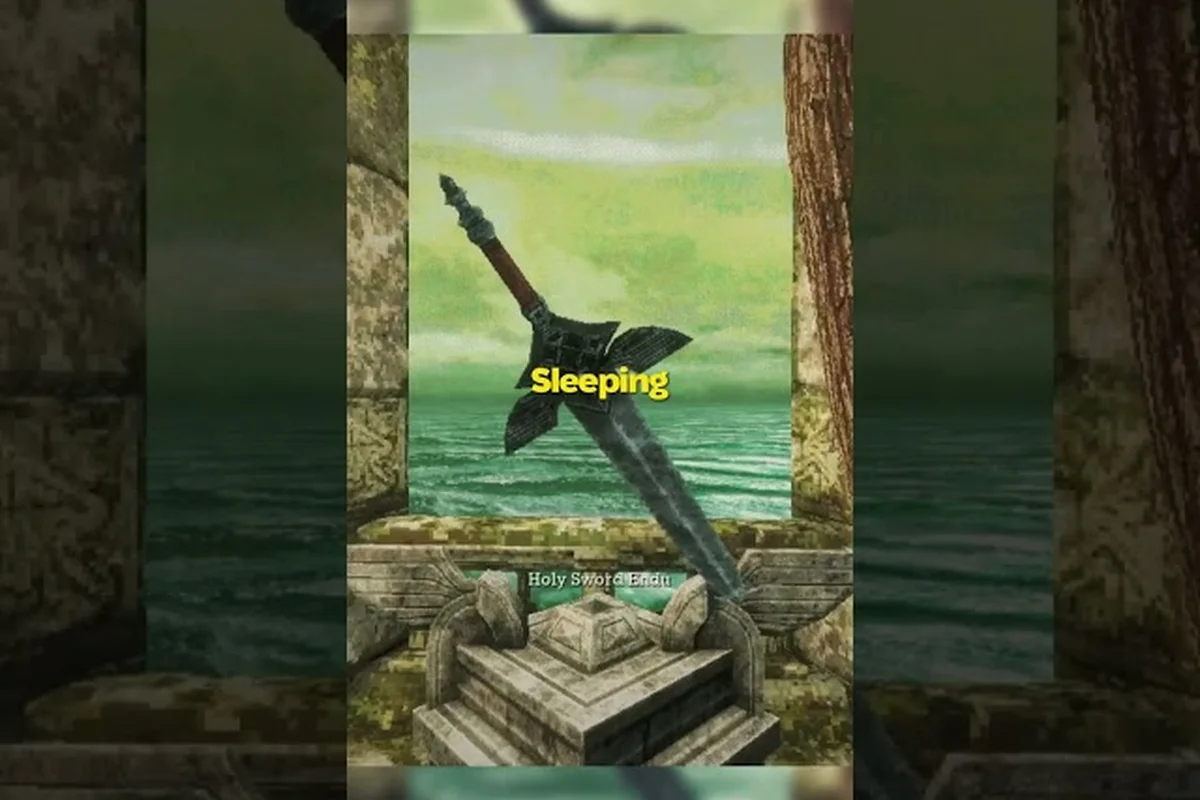
Queen's Domain flying turns the Legendary Holy Sword Endu into a practical route-planning tool. Knowing how to cross gaps, upgrade flight range, and read vertical space helps you explore the island without mistaking every cliff for a dead end.
Holy Sword Endu and the Main Queens Domain Traversal
The Legendary Holy Sword Endu is the game’s principal traversal tool, letting the player fly between platforms and cross gaps that cannot be reached on foot. Flight is not a side activity or a cosmetic animation; it directly determines how much of the interconnected island can be explored. The official Queen's Domain launch trailer specifically shows Holy Sword Endu flight across gaps, confirming that aerial movement is central to the intended route.
This matters because cliffs are the main gating feature of the island. A route blocked at ground level may reopen above it if you can identify a suitable launch point, a reachable ledge, and a clear landing. The sword’s flight distance can also be extended through upgrades, turning an initially impossible crossing into a manageable jump later in the run.
| Traversal condition | What is documented | Practical consequence |
|---|---|---|
| Gap between platforms | Holy Sword Endu enables flight | Look upward before deciding a gap is impassable |
| Very wide gap | Flight range can be upgraded | Return with a better range rather than forcing a risky attempt |
| Tall cliff | Vertical flight is part of traversal | Search for a higher platform or intermediate ledge |
| Fall into water | Water return pits return the player | Treat falls as a navigation setback, not a permanent failure |
| Long journey | The island is interconnected | Plan around flight range and repeated landings |
Holy Sword Endu flight range is the clearest traversal progression to watch. The official documentation confirms that upgrading the sword extends flight distance, although it does not provide exact values, upgrade locations, or a required sequence. Those details are not documented as of 2026-10-31 and should be verified in game rather than inferred from visual distance.
Reading the sword rather than the animation
A successful Queens Domain traversal attempt begins before takeoff. Face the next platform, note the nearest usable ledge, and identify what lies beyond the landing area. A broad visual gap can appear safer than a narrow one if the far side is higher, unstable, or obstructed by architecture.
The Holy Sword Endu responds to the character’s angle and momentum, so reading the route means tracing the diagonal path, not just the visible horizontal gap. A platform that looks close can still be impossible if the required climb exceeds the Endu’s available lift, while a distant ledge may be easier to reach by using a lower launch point and preserving forward speed. Before committing, compare the destination’s height with the departure surface and look for an intermediate route through Queen’s Domain architecture; a small height advantage can reduce the distance needed for the crossing.
-
Identify the nearest platform edge where flight can begin safely.
-
Estimate the full gap, including a small margin for imperfect alignment.
-
Locate a landing surface that offers space rather than a thin decorative ledge.
-
Check for vertical options, because a higher route may shorten the horizontal crossing.
-
Fly only after the route has a clear destination, rather than jumping in the hope of finding footing.
This approach makes the Holy Sword Endu feel more controllable because it turns an open space into a series of checkpoints. If a flight fails, the useful information is not simply that the jump was too long. Determine whether the launch angle, horizontal distance, height, or landing choice caused the failure. A broader overview of the island’s systems appears in the Queen's Domain beginner guide.
Crossing Gaps by Testing Distance and Angle
Learning how to cross gaps in Queen’s Domain requires controlled testing, but the game does not publish a flight-distance meter, safe-angle indicator, or numeric calculation. Distance must therefore be judged through sight, repeated attempts, and knowledge of the sword’s current range. Community experience should be treated as a practical observation rather than a substitute for official information.
The best test gaps are short enough to retry without a dangerous fall. After completing one crossing safely, note three visible properties: the apparent width, the height difference between launch and landing, and the amount of open space around the destination. Those landmarks become a personal benchmark for later jumps.
| Gap type | Likely difficulty | Better first approach |
|---|---|---|
| Narrow platform gap | Low | Direct flight from a level launch point |
| Wide platform gap | Medium | Line up the landing before committing |
| Rising gap | Medium to high | Add height and seek a higher launch point |
| Falling gap | Medium | Confirm a landing lower than the takeoff |
| Gap with no visible landing | High | Search sideways for an alternate platform |
| Gap beyond current range | High | Upgrade flight range and return later |
Landing alignment matters as much as raw distance. A jump that reaches the far platform can still fail if the character strikes its side, clips a raised edge, or lands too close to a drop. When possible, choose a landing area that extends back toward the launch point; it provides room to recover even if the approach is imperfect.
A repeatable gap-crossing method
Begin with a cautious jump to establish whether the sword can reach the next platform. Do not immediately attempt a longer version of the same route. Instead, repeat the crossing from a slightly different launch position, then compare the result with the first attempt. Consistent success suggests that your visual calibration is improving, while inconsistent results point to angle or landing choice rather than range alone.
The core answer to how to cross gaps is therefore sequential: establish a baseline, adjust one variable, and repeat. Change the launch position before changing the landing target; change the flight height before adding horizontal distance. This method makes each failure produce a usable lesson and avoids treating every failed jump as the same undifferentiated problem.
When to stop widening the gap
If two nearby platforms are impossible at the current upgrade level, do not spend every attempt on the widest version of that route. Look for a lower platform, a side route, or a route that begins one elevation higher. The connected island design means that flight often reveals alternatives that cannot be understood from a single ground-level corridor.
Also note the difference between a failed flight and a fatal fall. The version 1.01.01 patch added missing water return pits around Neasied, confirming that water can return the player after a fall. Before attempting a major crossing, identify the nearest water return point and use the backtracking and shortcut guide for related recovery planning.
Vertical Exploration and the Value of Upgraded Reach
Queens Domain vertical exploration follows the same central rule as gap crossing: first establish where the player can fly, then use elevation to reduce horizontal pressure. Upgrading the Holy Sword Endu extends flight distance, so a higher route may be unavailable during an early visit but become practical after progression.
The island’s interconnected structure makes vertical reconnaissance valuable. A ledge above the current path can reveal a platform, shortcut, or route across a later obstacle. However, the official sources do not publish a list of secret regions, towers, or named vertical zones. The only confirmed place names are the Isle of Neasied and the Pit of Despair, so this guide avoids inventing a map of undisclosed locations.
| Exploration clue | Interpretation | Action |
|---|---|---|
| Cliff continues upward | A higher route may exist | Find a takeoff point and ascend in stages |
| Platform sits above a gap | The flight may need more height | Gain elevation before crossing |
| Sword cannot reach a distant ledge | Range may be insufficient | Upgrade and return |
| Deduction points beyond a wall | A hidden route may sit above | Trace the wall vertically |
| Water return pit below | A fall is recoverable | Note its position before exploring |
Elevation staging is the most useful concept for vertical exploration. A long climb can be divided into several short flights, each ending on a stable ledge. This reduces dependence on maximum range and creates safe checkpoints where you can reassess the route before attempting the next ascent.
Searching upward without losing the return route
Begin by turning away from the immediate objective and tracing the cliff face from bottom to top. Look for natural shelves, ruined platforms, or architecture that interrupts the drop. These features often reveal possible flight stages even when the official world map does not.
After reaching a new elevation, compare three elements: the visible target, the flight meter remaining on arrival, and the distance back to the last confirmed landing point. Treat an upward flight as one stage of a Queen’s Domain traversal route, not as an isolated shortcut: if the new shelf cannot support another launch or return to the preceding ledge, the climb may consume the available range without improving access to the next platform. This comparison also distinguishes genuine vertical exploration from a quick flyby that leaves the player stranded above the cliff face.
-
Visibility: Can you see a platform, opening, or path that was hidden below?
-
Reachability: Can you return to the previous ledge without consuming all of the available range?
-
Purpose: Does the height lead toward useful progress, or only toward a dead-end decoration?
A route is rarely valuable solely because it reaches higher ground. The strongest vertical routes improve access, reveal the next platform, or create a shortcut back to earlier terrain. For broader rules about progression and the island’s interconnected design, consult the Queen's Domain exploration guide.
When to upgrade before exploring again
If several nearby gaps exceed the sword’s current range, treat them as evidence that an upgrade may soon be available rather than repeatedly failing the same jump. Exact upgrade requirements are not documented as of 2026-10-31, so confirm the Holy Sword Endu’s progression condition in the game.
The key decision is whether to return immediately or continue searching locally. An upgrade can make a distant route possible, but it may also reveal that the shortest crossing is still too wide. Compare the upgrade’s expected benefit with your available resources and only commit once the route’s endpoint is credible.
Queens Domain Hub Areas and NPC Status
No official Queen’s Domain hub area or named roster of Queen’s Domain NPCs was published as of 2026-10-31. The developers have documented an interconnected island, the Isle of Neasied, the Pit of Despair, water return pits, and several named creatures, but they have not published a map, region list, chapter structure, NPC list, merchant roster, or fast-travel network.
That distinction matters for navigation. A visually busy settlement cannot safely be called a hub without in-game confirmation, and an interactable figure cannot automatically be classified as a merchant, guide, blacksmith, or quest giver. The safest method is to record what the game itself labels and what each interaction visibly provides.
| Possible observation | Safe interpretation | Unverified claim to avoid |
|---|---|---|
| Several paths radiate from one area | Local route junction | Official fast-travel hub |
| A character offers a dialogue option | Named or unnamed NPC | Merchant or quest giver |
| A room contains a crafting function | Service location | Blacksmith or shop |
| Repeated paths return to one area | Central navigation point | Canonically designated hub area |
| A figure stands near a save point | Possible service interaction | Camp, town, or named hub |
Water return pits are the only documented navigation-support points around Neasied. They return the player after falling into water, but their activation rules, respawn delay, and relationship to save points are not documented as of 2026-10-31. Verify those details through repeated in-game tests rather than assuming that every return pit functions as a conventional checkpoint.
A reliable way to document local hubs
Use a simple three-part record for any area that feels central. First, note the number of routes leaving it. Second, list the useful functions available there, such as recovery, progression, or a route change. Third, record any label or dialogue that the game provides.
This avoids turning visual impressions into false geography. If an area has three connected passages but no confirmed function, describe it as a junction, not a hub. If an interactable character performs one action but has no published role, record the action instead of assigning a profession.
The same caution applies to the bestiary. It is an in-game encyclopedia whose entries can be scrolled with a controller, but its contents do not establish a complete list of NPCs. A bestiary entry named for a creature confirms an enemy, while an unnamed person encountered in the world requires direct observation before any classification.
Navigation implications when hubs remain unconfirmed
Because no fast-travel system has been confirmed, repeated area visits may still be part of normal traversal. Record the return path between landing sites, especially where flight is required. A reliable route should be reproducible without relying on a remembered cutscene, visual landmark, or presumed teleport.
This is also why the Holy Sword Endu deserves priority in planning. If every useful route depends on flight, losing the sword or facing an unclear return route can make an apparent hub less useful than a remote ledge with a direct connection to the next objective.
Flight Practice Routes for Better Queens Domain Navigation
Effective Queens Domain flying requires a progression of small practice attempts, not a sequence of reckless maximum-range jumps. Begin with safe platform edges, add height gradually, and only then test wide gaps. The objective is to make distance judgment consistent so that difficult climbs consume less time and fewer recovery attempts.
A practical Queens Domain flying route can be created without relying on an undisclosed map. Start from a recognizable point near the player’s current location, identify two nearby platform edges, and link them with short, repeatable hops before increasing the gap. For example, a three-hop circuit between the Queens Domain hub area and adjacent ledges lets pilots test glide distance without leaving the visible route area; if a jump requires correction, return to the hub area and reset rather than extending the run. This makes queens domain traversal measurable while keeping queens domain how-to-cross-gaps practice focused on repeatable spacing.
Route one: level platform crossings
Find two platforms at similar elevation with a modest gap between them, using the marked launch point as your takeoff reference. Aim for the nearer end of the destination platform rather than its center, since a short correction after landing is safer than overcorrecting mid-flight. For example, if the first crossing succeeds from the left edge of the launch point but misses the far platform from the right, return to that left-edge alignment. Repeat the route until the flight angle, takeoff position, and landing side are dependable, then slightly reduce the margin of error.
The useful checkpoint is consistent edge placement. A player who lands in the same portion of a platform several times has a dependable visual reference for later routes. The Queen's Domain gameplay overview provides context on how traversal fits the broader action role-playing experience.
Route two: rising gaps
Next, choose a platform that is slightly higher than the launch point, creating a rising gap rather than a flat traversal. Gain a little vertical distance first, then add horizontal movement to reach the platform’s edge. For example, if the hub area’s next landing is above the starting ledge, fly upward until your Queen’s position clears that height, then drift across. This isolates the height variable, reduces the risk of mistaking a vertical offset for a horizontal gap, and helps you plan safer Queens Domain traversal while approaching vertical exploration.
Route three: descending crossings
Select a lower platform with a visible, clear landing area. Descending crossings can feel safer than equal-height jumps, but they still require commitment. Avoid choosing a landing point directly above water unless you have confirmed where the water return pit will place you.
Route four: layered vertical ascent
Find a cliff or wall with at least two possible ledges. Use the lower ledge as a staging point, then reach the upper one. Repeat the sequence from another nearby angle. This teaches staged ascent, a practical form of Queens Domain traversal that remains effective when total flight range is limited.
Route five: the maximum-range benchmark
At the current upgrade level, find the widest clearly marked gap you can reasonably attempt. Cross it only after completing the other routes. Record the successful launch point and landing point, then compare them with later upgrades to understand how flight distance has changed.
| Practice route | Main skill trained | Ready-to-attempt threshold |
|---|---|---|
| Level platform | Basic gap reading | Distance is consistently crossed |
| Rising gap | Height control | Lower platform remains reachable |
| Descending crossing | Commitment and landing focus | Destination is visible and clear |
| Layered ascent | Staged vertical planning | Two landings fit the route |
| Maximum-range benchmark | Flight-range calibration | All shorter routes are repeatable |
Flight practice logs should record only observable details: upgrade state, launch surface, landing surface, height difference, and whether water or another hazard appeared. The game does not document exact flight values, so measured visual landmarks are more reliable than guessed numbers.
Practical Checklists for Safe Island Traversal
Before committing to a long crossing, confirm the sword is equipped, the launch edge is stable, and the intended landing is visible. Then check for water return pits, remaining stamina for combat after landing, and whether the route offers an alternate plan. This practical checklist works even though official sources do not publish a full map.
Treat flying as a positioning tool rather than a shortcut: fly to a stable ledge only when the sword is equipped and the landing edge is visible, then move through the Queens Domain in short, controlled arcs. If a crossing would end above water, use a nearby return pit as the recovery route; if the destination contains enemies, preserve enough stamina for combat. This matters because official materials confirm neither a full map nor a separate flight-stamina meter, so route certainty and combat readiness must come from observation.
-
Survey from the ground, including the underside and upper edges of nearby platforms.
-
Identify two landing choices, ideally one direct and one lower.
-
Test the shortest viable route, not the widest possible jump.
-
Adjust one variable per attempt: position, height, or distance.
-
Land with combat awareness, because reaching the platform does not guarantee a safe encounter.
-
Record a repeatable return point before moving deeper.
| Preparation state | Action | Reason |
|---|---|---|
| Clear landing visible | Fly directly | Lowest uncertainty |
| Landing partly hidden | Approach from a side angle | Reveals the true edge |
| Flight range insufficient | Upgrade or seek a higher route | Avoids repeated failure |
| Water below | Locate return pit | Makes recovery predictable |
| Enemy near landing | Prepare a stamina-based attack | Preserves mobility after arrival |
| No safe return visible | Delay the crossing | Prevents route lock-in |
Combat and flight share the same character because the game uses a stamina meter for combat. The official materials do not document a separate flight stamina system or a flight-stamina recovery rate, so do not assume that hovering or repeated short flights consume the combat meter. Nevertheless, arriving without enough stamina for an unavoidable enemy creates a larger practical problem than the jump itself.
Adjusting when the route changes
A connected island can alter after upgrades, encounters, or the discovery of shortcuts, although specific dynamic-route rules are not documented as of 2026-10-31. If a previously successful crossing looks different, compare current elevation, nearby platforms, and any newly opened passage. Do not rely on a community route without confirming it against your current progress.
The same standard applies to community reports. Player experience can reveal useful visual routes, but official patch notes and in-game behavior carry greater authority. In particular, the 1.01.01 fixes for the Pit of Despair, missing Neasied water return pits, and other issues mean that an old route description may no longer match the current build.
Frequently Asked Questions
Can the Holy Sword Endu cross any gap in Queen's Domain?
Not necessarily. Upgrading the sword extends flight distance, and cliffs remain the main source of gating, so gap width, elevation, landing space, and current upgrade level all matter. There is no documented maximum range, and some routes may require a higher takeoff point rather than simply more distance.
What is the best way to learn how to cross gaps safely?
Begin with short, level platform crossings and note the visible width of each successful jump. Then add height gradually while keeping the landing in view. Change only one variable per attempt, and use nearby platforms as staging points rather than committing directly to the widest gap.
Does upgrading the Holy Sword Endu improve vertical exploration?
Yes, because an upgrade increases flight distance and can make higher or more distant platforms reachable. It does not automatically reveal hidden routes, and no official list of secret vertical areas is available. Explore cliffs from several angles and verify whether a new ledge offers progress or a return path.
Are there official hub areas or NPCs in Queen's Domain?
No Queen’s Domain hub area or named NPC roster is documented as of 2026-10-31. The island contains the confirmed Isle of Neasied and Pit of Despair, while water return pits are documented around Neasied. Treat suspected hubs as local junctions until the game itself confirms a broader function.
Should players practice flying before upgrading the sword?
Yes. Repeating safe crossings teaches distance and landing judgment that remain useful after an upgrade. Once the current range becomes consistent, test wider gaps and revisit known cliffs. That sequence makes it easier to tell whether a failed route reflects poor technique or insufficient flight range.
Queen's Domain flying is ultimately a process of observing, testing, and recording. The Holy Sword Endu extends the island’s usable routes, while upgraded flight range and careful landing choices support deeper vertical exploration. By measuring gaps locally, treating undocumented hubs cautiously, and keeping reliable recovery routes in mind, players can turn aerial movement into dependable progress rather than repeated guesswork.